

ESTAMOS AQUÍ — WE ARE HERE
Happy Latinx Heritage Month! We come together to celebrate the collective heritage of Hispanic and Latinx communities across the U.S., honoring the cultures, histories, and contributions that connect people whose roots trace back to Spain and to 19 nations and territories across Latin America and the Caribbean. This year’s theme, "ESTAMOS AQUÍ — WE ARE HERE," declares presence, resilience, and belonging, lifting up the everyday lives and leadership of our families, workers, artists, students, elders, and organizers.
Latinx Heritage Month marks a legacy of political independence and resistance to colonial dominance, not just a cultural celebration. It begins in mid-September to align with Latin American independence milestones.
Originally a week-long observance in 1968 during the Civil Rights Movement, it bridges hemispheric independence history with modern movements for language access, labor rights, and racial equality.
On Terminology
The term, Hispanic (coined by the U.S. government in the 1970s) centers on language ties to Spain, which can sideline Afro-descendant, Indigenous, and non-Spanish-speaking identities.
The term Latinx emerged from academic and activist spaces to emphasize geographic roots in Latin America and the Caribbean, explicitly embracing Indigenous and Afro-descendant identities while moving beyond gender binaries and colonial frameworks.
No single term captures this entire diaspora, so ethical representation means respecting how individuals choose to identify.
"ESTAMOS AQUÍ — WE ARE HERE" calls us to recognize presence, demand dignity and inclusion, and stand in solidarity for a more just and vibrant future.
-
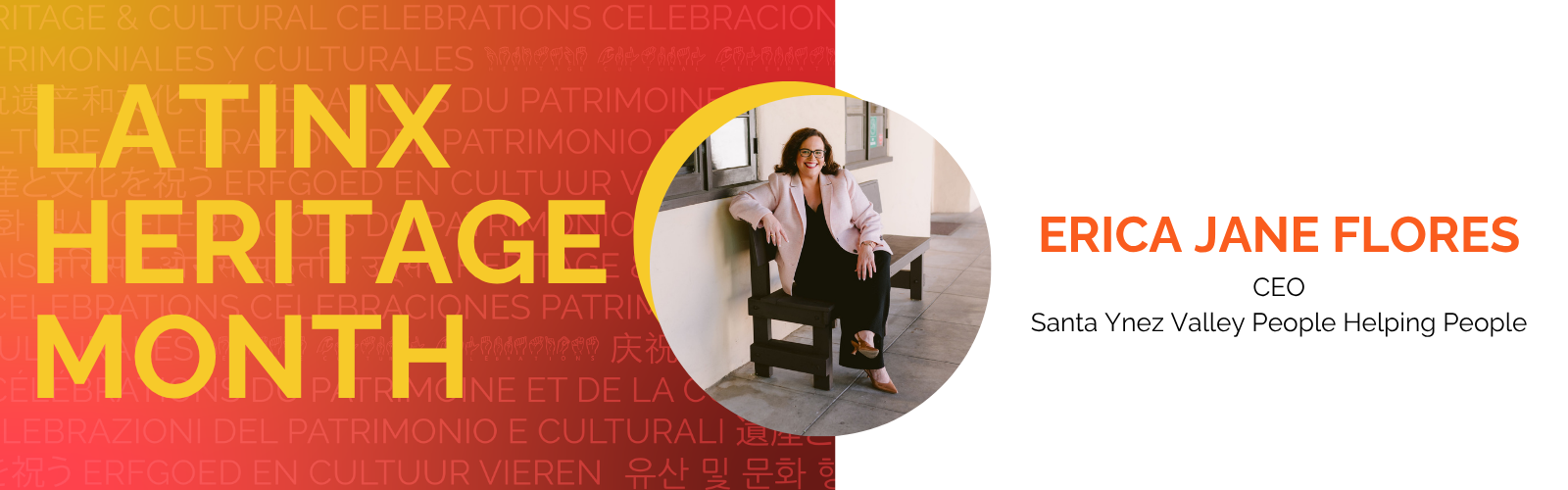
Erica Jane Flores (she/her/ella) is CEO of Santa Ynez Valley People Helping People, where she leads efforts to strengthen families, empower youth, advance health, and build a more resilient community. A fourth-generation Santa Ynez Valley resident and former People Helping People client, Erica brings both lived experience and a deep commitment to ensuring neighbors have opportunities to thrive.
A first-generation college graduate and daughter of a Mexican-born migrant farmworker, Erica’s career has included leadership and advocacy work with national organizations and alongside the White House and federal agencies. Locally, she has served as a school board trustee, nonprofit board leader, and community advocate. She currently serves as Vice President of the Allan Hancock College Foundation.
Named the 2024 Woman of the Year for California’s 37th Assembly District, Erica believes lasting change happens when communities invest in people, remove barriers, and create pathways for every generation to flourish.
-
What does your participation in this celebration mean to you personally?
For a long time, I think I took for granted what it meant for me, as a Latina, to lead an organization in the community that raised me. This Mother’s Day changed that perspective. I received cards from several of the Latinas I have the privilege of leading, sharing what it meant to them to see a Latina CEO who is also a mother—someone navigating leadership, motherhood, culture, and identity alongside them. Their words made me understand my own leadership differently.
Representation can feel abstract until someone tells you that seeing your life has helped them imagine something more for their own. I realized that honoring our heritage is not only about remembering those who came before us. It is also about what we make possible for those beside us and those who will come after us. I carry tremendous pride in where I come from, but also a responsibility to lead in a way that allows other women—and especially our daughters—to see that their culture, motherhood, ambition, and leadership do not have to exist in separate spaces. They can bring all of who they are with them.
Who/What inspires me: My daughter is my why. She and I went to the Obama Presidential Center in Chicago, and to experience history with her was deeply inspiring.
An interesting fact about me: I just completed a program at Harvard Business School for CEOs of non-profits from 18 countries. I lived on a ship for 80 days.
A podcast, book, film, or documentary, or an interactive learning experience that you recommend that will continue the learning of our audience: I recommend taking time to map your own journey. A Harvard leadership exercise challenged me to reflect on the people, experiences, identities, and pivotal moments that shaped me. Understanding how you arrived at this moment can reveal what you have taken for granted and help you lead and live more authentically.
Conversation Guide
Use the discussion questions to engage in meaningful conversations during Latinx Heritage Month and beyond. These questions can help facilitate discussions that not only raise awareness but also lead to actionable insights and improvements in organizational practices.
Conversation Starters
What do you think the early advocates of Latinx Heritage Month observances wanted for future generations? How are we doing at meeting those expectations?
How do you believe acknowledging and learning from our history contributes to the empowerment of LGBTQ+ communities and the shaping of a more equitable future?
"ESTAMOS AQUÍ — WE ARE HERE." What does “honoring Latinx Heritage Month” look like in practice beyond September?
-
Use these questions to drive your own reflection and exploration of the themes raised by the theme “ESTAMOS AQUÍ — WE ARE HERE"
We recommend: Journaling is a great way to explore this topic! Pick 1-2 questions and free-write your thoughts.cription text goes here
-
Want to engage your team? Slack, Teams, or your preferred digital conversation platform can be a great way to keep dialogue going. Try posing these questions in a group chat format. You might do 1 per day or 1-2 each week over the course of Latinx Heritage Month.
We recommend: Post the questions on consistent days and times so that your team knows when to expect them.
-
You can combine the video and these discussion questions as a Lunch & Learn, or All Hands experience for your organization.
We recommend: Depending on the size of your organization, you may want to use the questions to have small group or table discussions and then invite groups to share with the larger team.
Resources
-
Longest-running Latino news and cultural program on public radio.
Podcast helping entrepreneurs grow their businesses.
Latinx and Global Majority Voices share stories of growth, business, and liberation.
Queer, Latinx, and Spanglish voices explore identity, food, family, and history.
-
Books:
Bird of Four Hundred Voices: A Mexican American Memoir of Music and Belonging by Eugene Rodriguez
A memoir about confronting oppression and celebrating Mexico's musical influence on US culture.
Our Migrant Souls by Héctor Tobar
A personal journey decoding Latino identity, history, and impact in the US.
Harvest of Empire: A History of Latinos in America by Juan González
Explore five centuries of diverse, influential Latino history in America.
The Undocumented Americans by Karla Cornejo Villavicencio
A personal journey uncovering the resilience & realities of undocumented Americans.
The Alchemist by Paulo Coelho
A shepherd's journey to find treasure reveals the wisdom of following one's dreams.Description text goes here
-
Latino Vote: Dispatches from the Battleground
Explores the diverse, complex power of Latino voters in battleground states.
Latino Americans: The 500-Year Legacy That Shaped a Nation
Three-part series about the 500-year legacy, experiences, and impact of Latinx Americans on the nation.
Daughters of immigrants from Mexico navigate music careers and the pressure to succeed.
Personal video portraits of acclaimed Latino artists and leaders.Description text goes here
-
Latino Cultures in the US (Google Arts and Culture)
Explore the diverse cultures, stories, and modern experiences of Latinos across America
Smithsonian National Museum of the American Latino Virtual Exhibits
A virtual exhibit exploring U.S. Latina/o history, culture & legacy.
MOLAA en Casa: Museum of Latin American Art
A rich collection of Latin American virtual art exhibitions.
Keep the conversation going
Celebrating diversity and the amazing cultures that make up our society should not be limited to a day or even a month. We’ve already given you a few ideas, but here are even more ways that you can take the topics you explored in this HCC back to your team or organization.
-
Listen to podcasts on this topic while you go for a walk.
Use the discussion questions as journal prompts for self-reflection.
Teach it—even if it’s to an empty room! Sometimes, saying things out loud can prompt you to think about a topic differently.
-
Use the discussion questions during 1:1s.
Ask your direct report to lead a discussion using one of the questions.
Use the recommendations from the speaker panel to start a book club, watch club, or podcast club.
-
Lunch & Learns: Explore new ideas and connect with others in a casual, interactive session—all during your lunch break. It’s a great way to dive deeper into meaningful topics, like the ones in this guide, while fostering conversation and collaboration with your team or organization.
Shared Narratives: Share personal and cultural stories related to this month’s theme through prompts or an open forum. This activity brings people together, sparks meaningful conversations, and celebrates the unique experiences that make you stronger as a team.
Collaborative Art Project: Work together to create a visual representation of the theme, such as a mural, collage, or digital art piece. This hands-on activity encourages creativity, teamwork, and meaningful discussions about the cultural and heritage topics being explored.